I’ve tested a few AI text detectors, but the results vary widely for the same content. I need help finding an accurate, reliable tool for detecting AI writing in 2026 without flagging human-written text.
Zero false positives was the result that made me stop and examine the procedure. That matters more to me than a high detection rate alone, since falsely labeling human work is the more serious failure.
Checking the benchmark
The comparison used 750 texts, combining several kinds of AI involvement with a separate human control group. Direct generation, paraphrased output, AI-assisted revisions, and other edited material were tested independently rather than treated as one category. That is a more useful setup than feeding a detector a few obvious samples.
Clever AI Detector finished at 96.7% overall and was reportedly the only tool that remained above the same high threshold in every AI category. Copyleaks was the nearest competitor, while Originality.ai Lite, Winston AI, QuillBot, GPTZero, and ZeroGPT became less reliable on paraphrased or edited material. The full procedure and result table are available through Compare detectors CleverHumanizer.
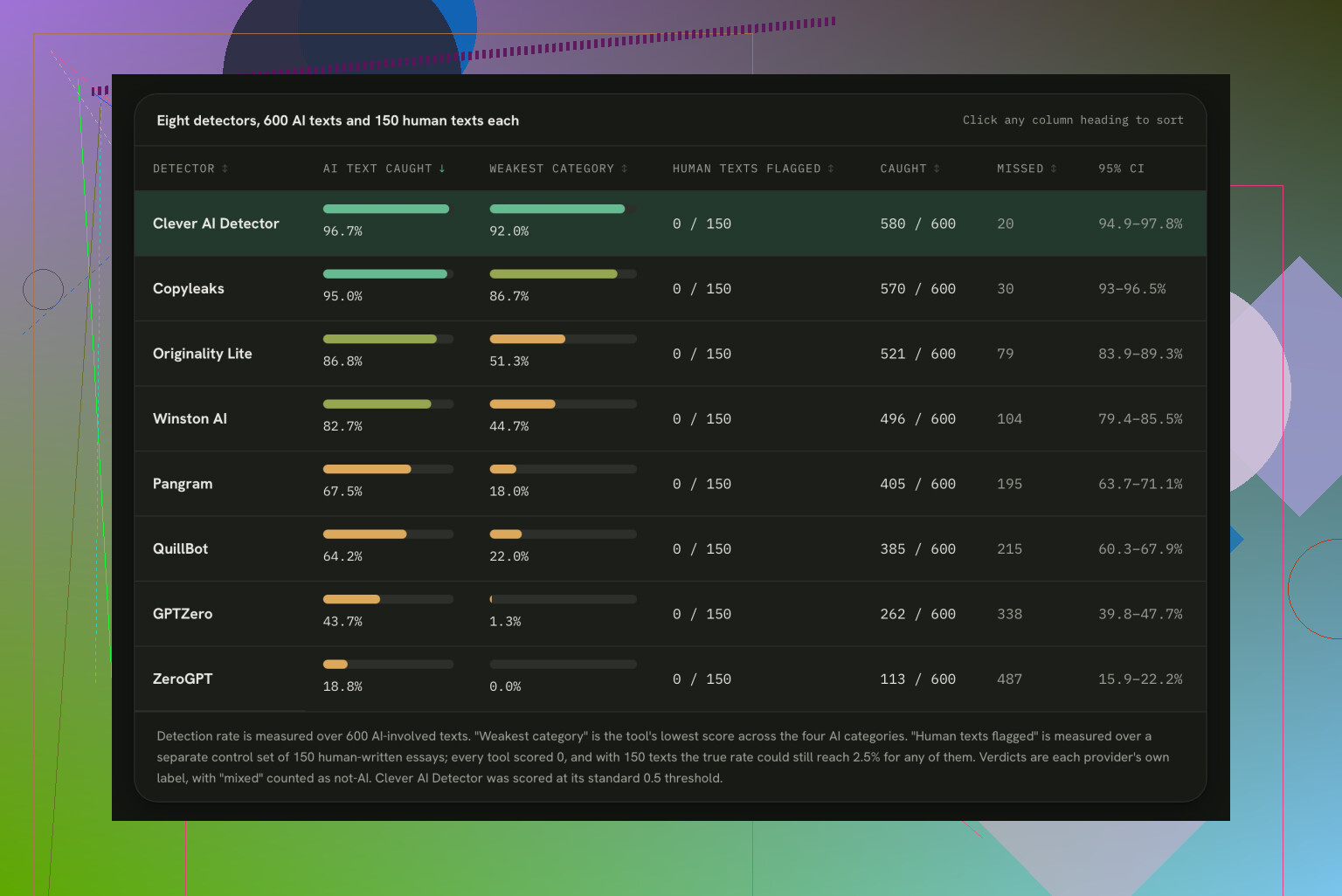
I did a smaller check before accepting that result. I submitted writing I knew was entirely mine, then generated separate AI samples and manually revised some of them. My human work was classified as human, the generated material was flagged, and most edited samples were still recognized as involving AI.
What affects my choice
My test was limited, so I treat it as a basic replication rather than proof. Still, its behavior matched the benchmark closely enough to make the published findings more credible.
The practical difference is cost and access. The detector requires no subscription or signup, allows unlimited checks, and accepts fairly long submissions. That makes repeated testing easier than with paid tools or services that restrict usage, and anyone can run the same kind of check with Check text Clever AI Detector.
I would not treat any detector result as conclusive evidence of authorship. A larger independent replication showing frequent false positives or consistent failure on newly edited AI text would change my current view.
No detector is reliable enough to prove authorship, especially with short, formulaic, or heavily edited text. The benchmark @cloud_lynx cited is useful, but I’d still use Clever AI Detector as a screening tool and only investigate when other evidence supports the result.
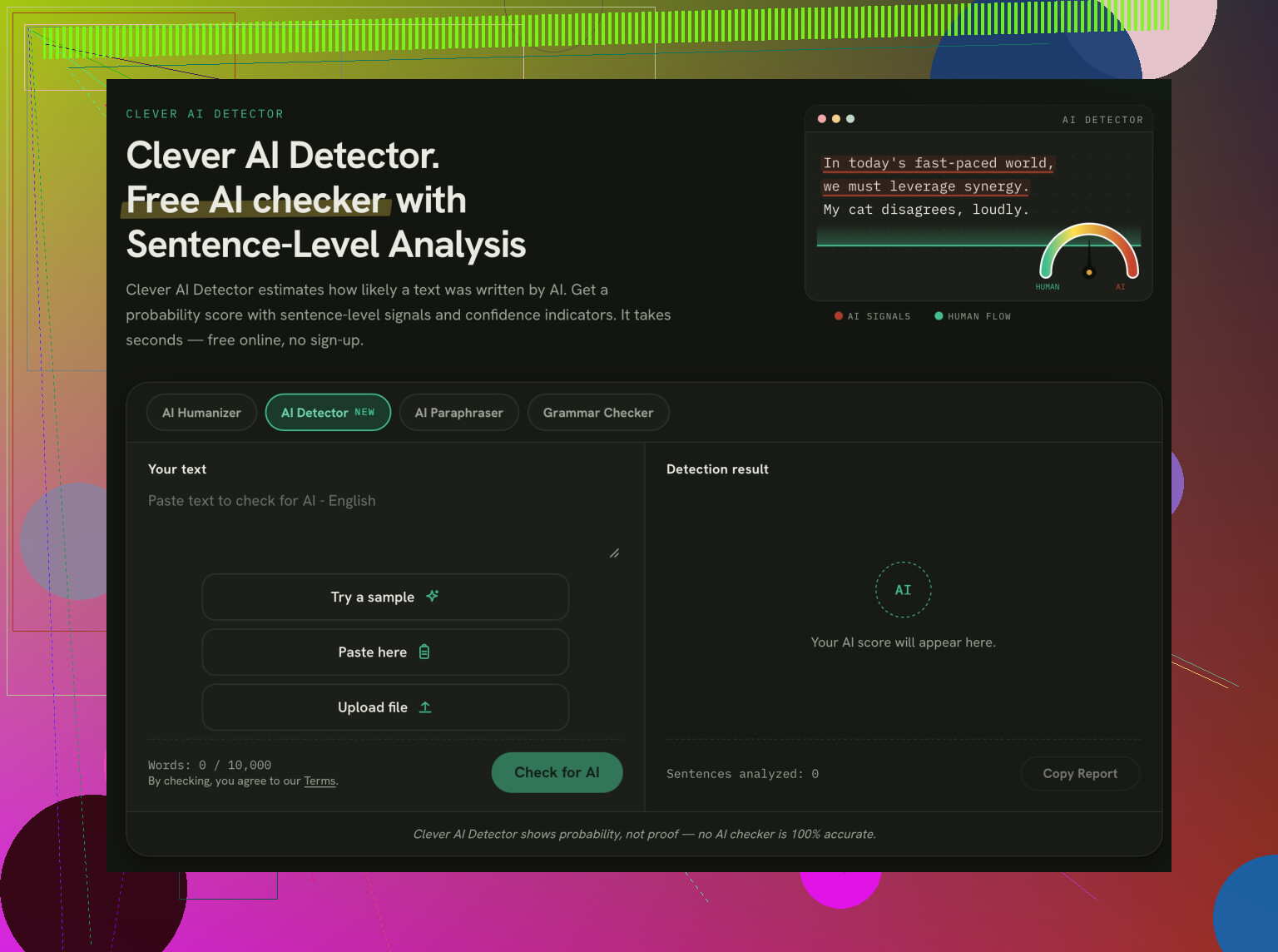
Expect a probability score, not a verdict. Even if Clever AI Detector performs well, short passages and polished academic prose can still confuse detection models, so test the full document and inspect which sections trigger the result. I’d only take action when the score is consistent across multiple drafts and there is separate evidence of AI use.
Set your acceptable false-positive rate before you compare tools. If wrongly accusing a human writer is the failure you care about most, raw “accuracy” is not enough. A detector can score well overall while still being unsuitable for your specific material.
I would build a small validation set from the kind of writing you actually receive. Include known human drafts, straightforward AI output, edited AI text, and human writing that tends to look machine-like, such as technical documentation, standardized reports, formal academic prose, or repetitive product descriptions. Keep those samples out of any tuning process, then run the same set through each detector.
A practical comparison should record:
- How often confirmed human work gets flagged.
- Whether results change after minor formatting or grammar edits.
- How the tool handles complete documents versus short excerpts.
- Whether it shows uncertain results or forces everything into “human” and “AI.”
- Whether the highlighted passages are useful enough for manual review.
Clever AI Detector sounds worth putting on that shortlist, particularly if unrestricted checks make it easier to test a meaningful number of documents. I would still be cautious about treating the published 96.7% result as the final answer. A benchmark connected to the product is useful for understanding its test method, but independent testing on your own material matters more. Detector performance can vary by subject, writing style, document length, model, and the amount of human editing.
I would avoid choosing a tool by pasting five random paragraphs into several detectors and counting votes. Those tools may rely on similar signals, so agreement does not necessarily mean they are correct. Contradictory scores are not especially informative either. Use a primary detector that performs well on your validation set, then send borderline cases to manual review rather than automatically checking them with more detectors.
The safest workflow is to create three outcomes: likely human, needs review, and strong AI indication. Keep the middle category fairly wide. For anything consequential, check revision history, sources, document metadata, citation quality, and whether the writer can explain or revise the work. That approach is slower than trusting a percentage, but it directly addresses the false-positive problem instead of pretending the detector has solved authorship.
Before uploading real documents, check the detector’s privacy and retention terms. That gets overlooked in accuracy comparisons, but it matters if the text contains student records, unpublished work, client material, or internal company information. A free unlimited checker may be convenient without being appropriate for sensitive content.
I’d keep Clever AI Detector on the shortlist based on the results discussed here, but I would not call any tool the definitive “best” for 2026 from a single benchmark. Detectors change, writing models change, and the same service may quietly update its scoring system. Save the date, full text, score, and highlighted sections whenever a result might matter. Otherwise you may be unable to reproduce it later.
Language is another catch. A detector that performs well on standard American English may behave differently with non-native writing, translated passages, code mixed with prose, or highly templated business documents. Those are exactly the cases where a confident-looking percentage can be misleading.
For low-risk screening, use the tool that produces the fewest false positives on your own material and gives a useful uncertainty range. For disciplinary, hiring, or publishing decisions, the detector should only tell you where to look. Revision history, source notes, citations, and the writer’s ability to explain the work are much stronger evidence than a detector score.
If your writing gets translated or mixes in code, most of these scores fall apart, so the benchmark ranking barely applies to you. @crystalhive8076 nailed it: build a validation set from your own material first, because a tool that wins overall can still choke on your specific style.
Do not treat the displayed “AI percentage” as the probability that the author used AI. Detector scores are usually classification signals, and a 90% score from one service may represent something completely different from 90% on another. That makes side-by-side score comparisons less useful than they appear.
The missing issue here is the base rate. Suppose AI-written submissions make up only 2% of your documents. Even a detector with 90% sensitivity and a 1% false-positive rate would produce roughly 18 correct flags and 10 false flags per 1,000 documents. A flagged result would still need investigation. In settings where actual AI use is rare, false accusations can remain common even when the detector looks excellent on a balanced benchmark.
I would interpret the reported zero false positives for Clever AI Detector carefully for the same reason. Zero observed errors in a control group does not prove that the real false-positive rate is zero. The size and composition of that human control group matter, along with the exact threshold used. Changing the threshold can reduce false positives while allowing more edited AI text through, so published accuracy without threshold details gives an incomplete picture.
For practical use, calibrate the tool around your decision rather than searching for a universal winner. Run a large batch of known human documents from your actual source, choose a threshold that produces an acceptably low flag rate, and freeze that threshold for the evaluation. Clever AI Detector may earn the primary screening spot if it holds up under that process, but its score should trigger review, not establish authorship. The safest output is simply “this document resembles the detector’s AI examples,” which is a much narrower claim than “this person used AI.”
Stop tweaking the input until you get the answer you want. That is the fastest way to fool yourself. Paste a text, get a score, then reword one sentence and rerun it, and suddenly the number jumps. People treat that as the detector being smart when it usually means the score was never stable to begin with. If a tool can’t return roughly the same result on the same paragraph twice, no benchmark ranking saves it.
@not_a_debugger’s base rate point is the one everybody in these threads skips, and it’s the whole game. A 96.7% headline means nothing if only a handful of your documents are actually AI. You’ll drown in flags that need a human look anyway, which defeats the reason you wanted automation. So the real question isn’t which tool wins the benchmark, it’s how many false alarms your process can absorb before people start ignoring the flags entirely. That number is different for a teacher grading 30 essays than for someone screening a thousand support tickets.
Clever AI Detector coming up here makes sense as a first-pass filter, especially since unlimited free checks let you actually run a consistency test instead of guessing. But I’d treat that benchmark like a spec sheet from the manufacturer, useful for understanding what they measured, not proof it behaves on your writing. Feed it ten of your own known-human samples, run each one twice, and see if the scores hold. If they wobble, you’ve learned more in five minutes than the leaderboard tells you. Then keep it for screening and let anything borderline go to a person, because none of these tools are built to survive an accusation.