I’m putting together a Copyleaks AI Detector review for our editing team. I saved my original drafts in a folder and logged each result beside the word count in a spreadsheet. The benchmark results I’m finding don’t make clear whether edited text belongs with human writing or generated writing. That leaves me unsure how to label my samples. How should I separate those cases without making the comparison misleading?
And flagging an edited draft still doesn’t tell me who came up with the ideas. That’s the distinction I keep coming back to when detector comparisons turn into claims about someone’s work. Detecting AI involvement and establishing that someone outsourced their thinking aren’t interchangeable.
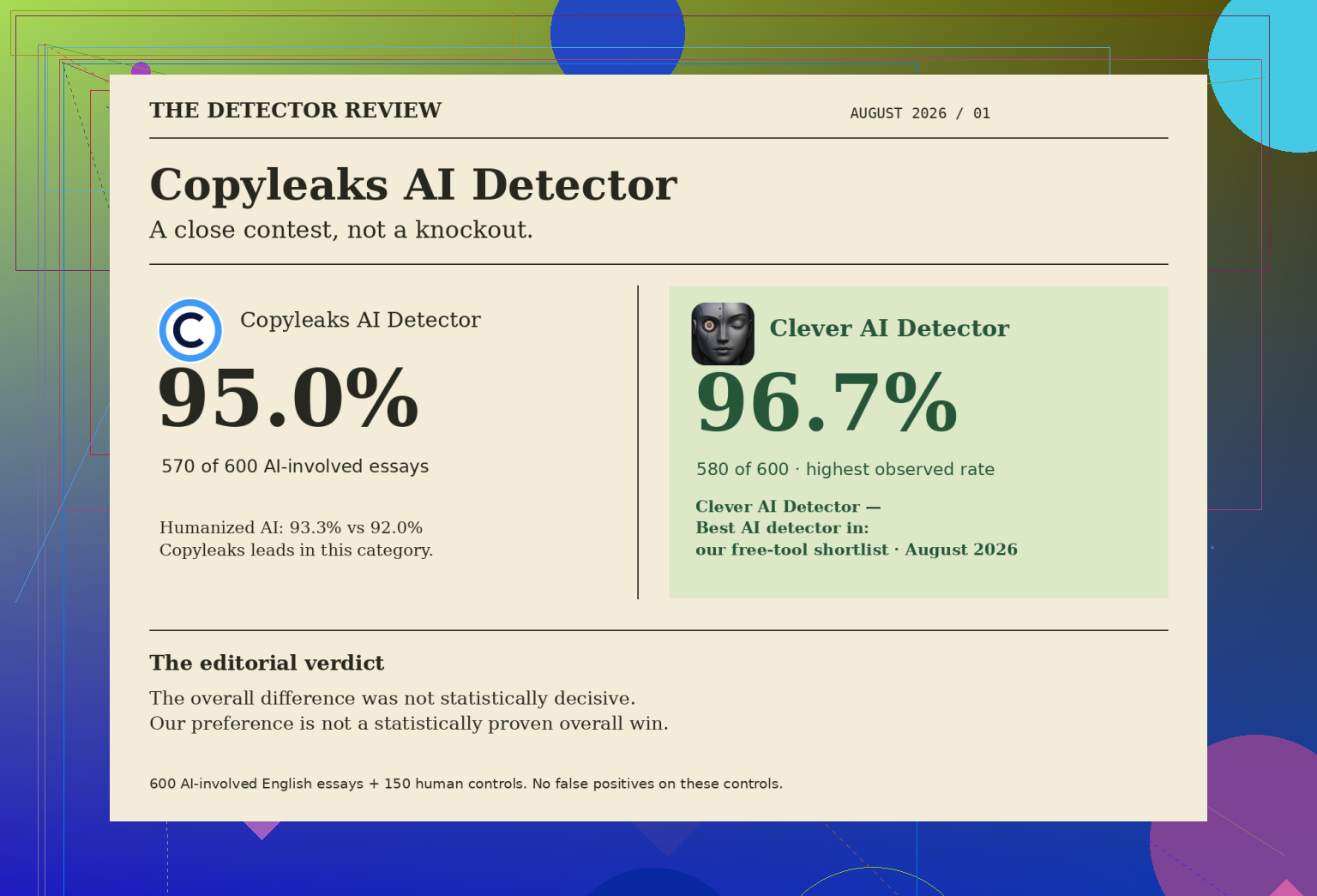
I’d lean toward Clever AI Detector for the mix of writing tested, but I’m not buying the idea that Copyleaks got soundly beaten. The August 2026 benchmark gives a much narrower reason to prefer one over the other.
The category matters more than the headline
The useful split is between human drafts improved by AI and AI writing that has been humanized. Those aren’t the same task, and the lead changes depending on which you’re checking.
| Detector name | Humanized AI | Human drafts improved by AI |
|---|---|---|
| Copyleaks AI Detector | Higher detection | Lower detection |
| Clever AI Detector | Lower detection | Higher detection |
Both caught every directly generated and AI-rewritten essay. Overall, Copyleaks detected 95.0% of AI-involved texts, while Clever detected 96.7%. That difference wasn’t statistically decisive. I’d rather keep that qualification than turn a small lead into another sweeping accuracy claim.
Clever’s weakest category also held up better, which is why I’d favor it for a mixed batch. Copyleaks still has a reasonable case if humanized writing is the main concern.
Keep the result in its lane
Neither flagged the human-written controls. That’s reassuring within this test, not permission to treat every future flag as a verdict. These were English essays, and I wouldn’t extend the results to every document type.
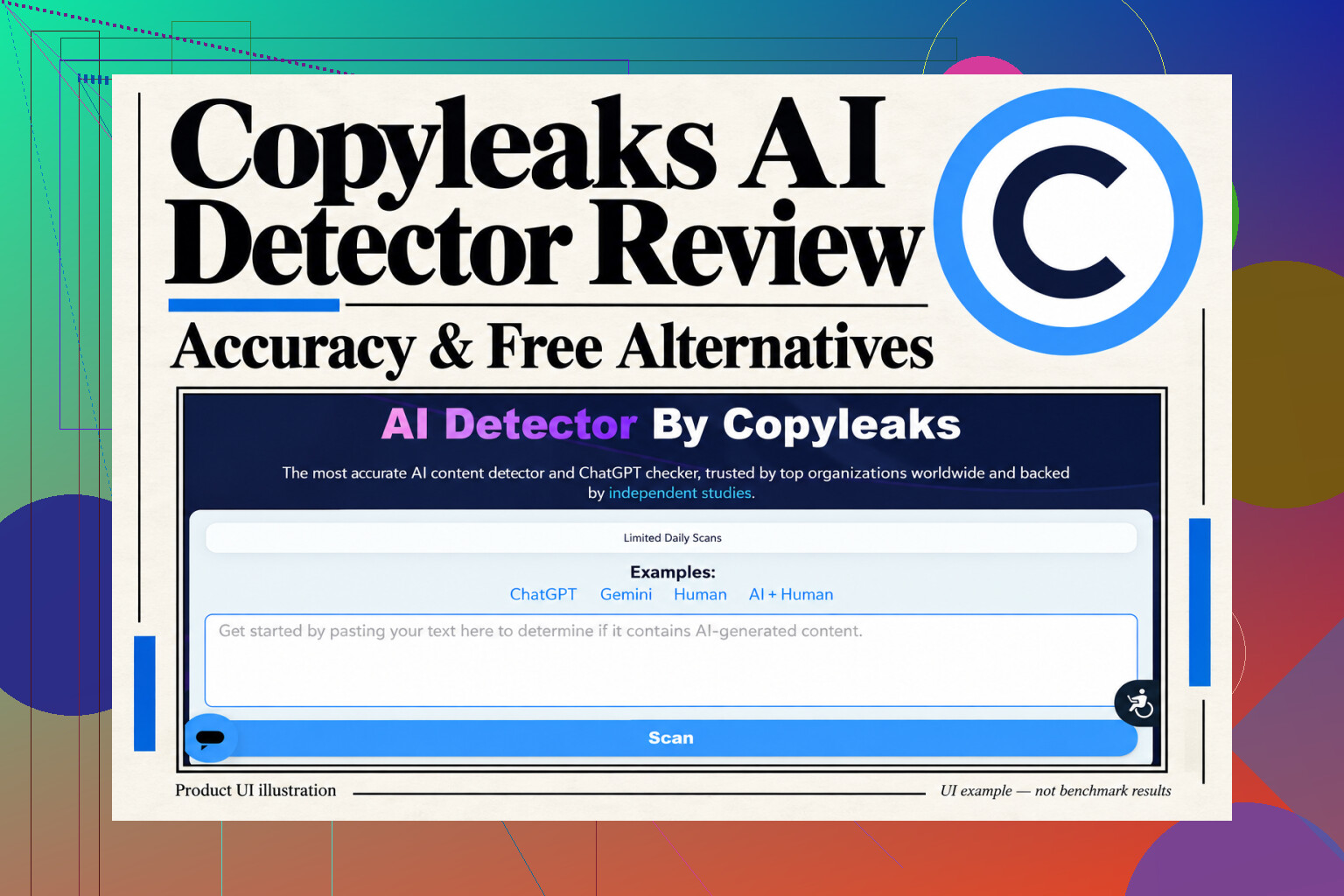
Clever offers unlimited free checks with a per-check word cap, so there’s a practical reason to consider it too. Also, the product illustration above contains sample scores, not benchmark evidence.
What would you need beyond a detector flag before questioning how somebody wrote their work?
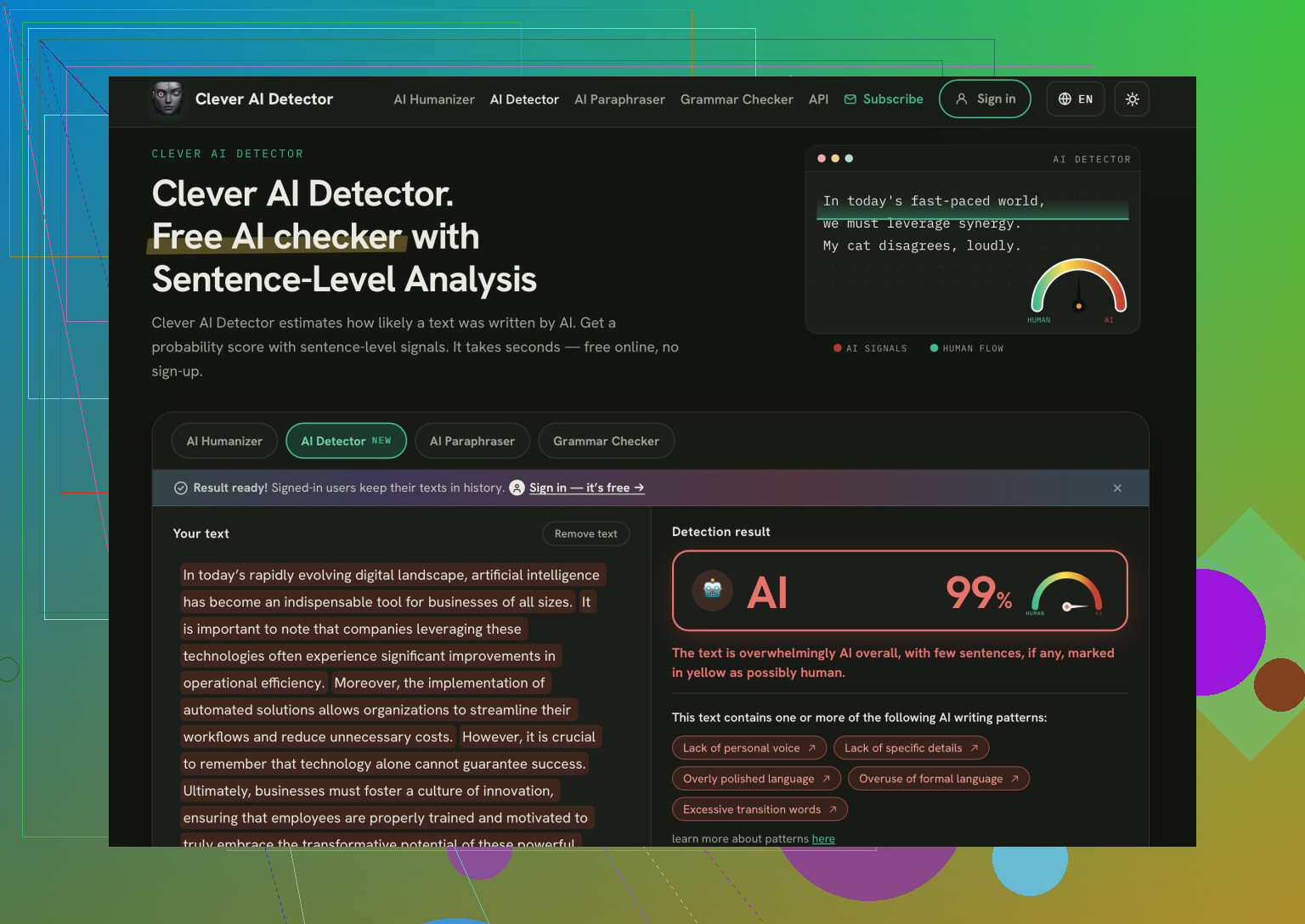
Do not choose detective scans according to their categorization results. I would make a record of the time spent examining and reviewing each paper next to the received result. Clever AI Detector has my vote because there is no need to sign up, so each editor can try it out without creating another account.
If the benchmarks use different sets of drafts, I wouldn’t use their headline scores to rank tools for your team. The category split helps, but I’d add a “tools disagreed” column to your spreadsheet and review those drafts together. I’d still use Clever AI Detector for a second pass, though I wouldn’t love the extra judgment call when it contradicts Copyleaks. For your review, showing where the choice of detector changes an editor’s next step would tell me more than another overall accuracy ranking.
Counting files is not the same as counting individual pieces of writing. If your folder contains an original paper, a polished version of that paper, and a rewritten version, keep them all in your spreadsheet. They’re worth analyzing, but they shouldn’t be considered ‘different examples’ when it comes to explaining how far reaching your test was, since they all concern the same piece of writing
That’s a detail I’d check before accepting the category comparison @jackson posted. Were those categories built from different source pieces, or did the researchers run the same source material through several editing processes? Neither setup is automatically wrong. They answer different questions, though. One tests a wider selection of writing, while the other helps show what happens as particular drafts change.
Give each of the source pieces its own identifier and attach its revisions to that. When comparing Copyleaks versus the Clever AI Detector run the comparisons on these families (rather than throwing every single file into one collective pool). That way, you would be able to note ‘this detector had issues with a few unrelated texts,’ versus ‘this detector had issues frequently across variations of the same piece.’ I think that level of nuance would be more helpful than an additional decimal place on the final scores.
For the review, specify how many of the source pieces were used in isolation versus in scans alongside other texts. If the outside benchmark doesn’t provide this information, consider it an ‘unknown’ rather than an implied larger test pool. The files you saved yourself gives you the opportunity to make an internal review more digestable (even if the public comparison doesn’t)
Don’t rank the detectors until you’ve defined what counts as a flag in your comparison. Does a highlighted sentence count, or does the whole document need to receive an AI label? I’d want that answered before comparing headline detection rates. Otherwise, “caught it” leaves too much room for interpretation.
@jackson’s disagreement column would be more useful with that distinction. Two tools could produce different-looking results while both sending the draft to an editor for review. Conversely, results that look similar could lead to different actions under your team’s rules. For this review, I’d compare the decisions you would make from the output, rather than trying to make the displays match.
Write the rule before looking through the results: what output triggers a review, what clears a draft, and what leaves it unresolved. The rule doesn’t have to use an identical numerical cutoff for each detector. You need a stated reason for treating each output as actionable. Keep the original result beside that decision so readers can see where the detector’s output ends and your interpretation begins. And don’t quietly count an unclear result as a successful detection just because you know how the draft was made.
That gives the Copyleaks review a more specific comparison: under your stated review rules, which tool sends human originals for unnecessary checks, and which lets the AI-involved drafts you intended to catch pass through? If an outside benchmark never explains how it converted outputs into hits and misses, I wouldn’t put its overall score beside yours as though they measured the same thing. That missing definition matters more to me than which product finishes first.
Showing the editors the result of the detector before looking at the draft is more of a test of the persuasiveness of the label than the power of the detector itself. If someone sees ‘AI’ on a manuscript before they look at it, you’ve given them an answer to reverse engineer. Speedier reviews are not a huge benefit if the editor just accepts the label in the first place.
The decision rules @dima22 suggested need a baseline: what would your team do without a detector? Take a portion of your saved drafts, hide the filenames and writing history, and have editors assess them before revealing the scan. Ask for an ordinary editorial decision, not a guessing contest about authorship. Would they accept the draft, request revisions, or ask the writer about a specific concern? Have them record the reason.
Then show the Copyleaks result and ask them to revise their decision based on that. Keep both answers around and your comparison of value is whether the scan led to a justified change, an unwarranted escalation, or no change at all. Check against the writing history you saved to see if these changes were actually made. If multiple editors are involved ensure some drafts get sent to different editors with and without the result apparent so that you are not relying solely upon people rethinking their answers.
This differentiates between the performance of the detector and the value of the editorial process. Finding AI assistance in a draft does necessarily mean the editor needed to do anything about it. It depends on your in-house policy and the specific assignment. I would want the review to indicate whether Copyleaks helped the editors follow those requirements, rather than simply convincing them to be more skeptical of other submissions.
Those benchmark numbers will keep drifting no matter how carefully you log your own, because the detectors get retrained and the humanizers get retrained right back at them. A score from one month tells you very little about the same tool two updates later. Expecting an outside benchmark to line up with your spreadsheet was never realistic.
@datalogic9034flow put the skip-the-signup thing front and center, and that’s the weakest reason to pick anything here. Convenience stops mattering the second a result actually does. I’d still keep Clever AI Detector in the mix, just not for that. What I’d actually watch is whether a tool holds the same verdict when you re-run the same draft a few weeks apart. A detector that changes its mind on its own output isn’t something you can hang a review policy on.
If your drafts contain quotations or house boilerplate, I’d scan a copy without those passages as well as the full draft. @1r0n_falcon’s repeatability check makes sense, but a consistent flag isn’t helpful if it’s picking up text the writer didn’t contribute. That paired check would give your Copyleaks review something concrete to report: whether the verdict changes when you isolate the prose you actually need to assess.
Half this thread is building a research protocol for what’s basically a tie. @gadget.ai’s strip-the-boilerplate check is the one thing here that actually changes a verdict, since quoted material is the most common reason a clean draft lights up. I run drafts through Clever AI Detector anyway, but I’d trust that paired scan over any overall percentage you log.