I’m trying to figure out if Ahrefs AI Humanizer actually helps content pass AI detection and still rank well on Google. I’ve seen mixed claims and don’t want to risk hurting my SEO or wasting money. Can anyone share honest experiences, pros and cons, and whether it’s worth using for long-form blog content?
Ahrefs AI Humanizer review, from someone who tried to make it work and failed
Ahrefs has a good name in SEO, so when I saw they had an “AI humanizer” inside their Word Count platform, I expected something half decent. I took it for a spin on a bunch of test paragraphs and the short version is: it looks fine to a human, but detection tools treat it as plain AI every single time.
Here is the reference link I used before testing:
And this is the UI it sits in:
What I tested and how it went
I fed it multiple blocks of text that were clearly AI written. Think standard GPT-style content, long sentences, generic intros, the usual.
Then I ran the “humanized” output through:
• GPTZero
• ZeroGPT
• Ahrefs’ own built in detector that shows a score above the result
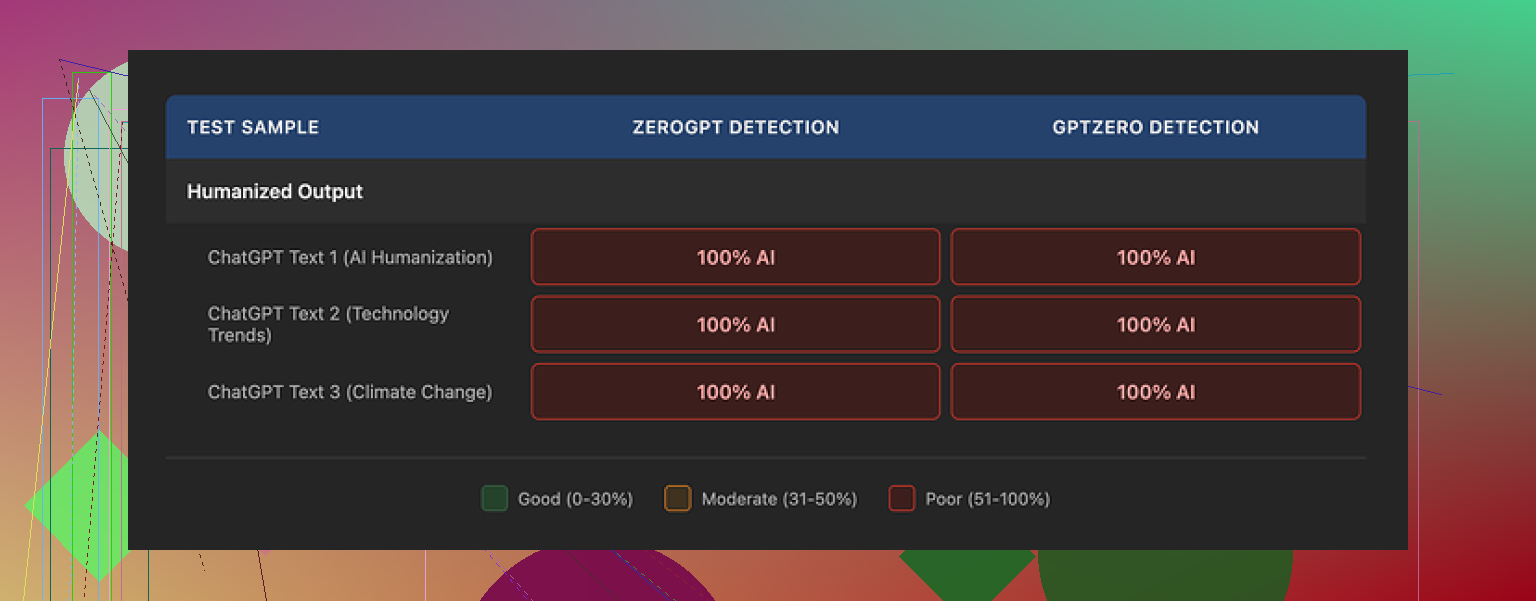
Every single time, both GPTZero and ZeroGPT flagged the humanized text as 100 percent AI. No borderline scores. Full red bar.
The weird part
Ahrefs shows a detection score right above its own humanized text. On my runs, that detector also said 100 percent AI for its own output.
So the flow looked like this:
- Paste AI text
- Click to humanize
- Get cleaned up text
- Ahrefs detector, sitting in the same interface, says “this is 100% AI”
So it is basically telling you, on the same screen, that the “humanization” did not work at all.
Screenshot of the behavior again:
How the output reads
Purely from a writing standpoint, it is not terrible. I would give it around 7 out of 10 for quality.
What I noticed:
• Grammar was clean
• Sentences flowed fine for blog type content
• It kept typical AI openers like “one of the most pressing global issues”
• It left em dashes untouched, which are a common AI fingerprint in longer pieces
• Tone felt like standard AI essay style, no specific voice
If your only goal is “make this text easier to read,” it does that to some extent. If your goal is “get past AI detectors,” in my tests it failed across the board.
Controls and customization
The tool is bare bones.
• You can pick the number of variants, up to five
• You cannot tune tone, style, or formality
• You cannot exclude certain phrases or patterns
• No per sentence settings, nothing about randomness or creativity
Theoretically you could:
- Generate three to five variants
- Manually pull the most human looking sentences from each
- Stitch them into a new version
- Run that new version again through a different tool
But at that point you are doing manual editing work. It is not a one click “fix my AI text” type of experience.
Pricing and restrictions
The humanizer lives inside Ahrefs’ Word Count platform.
From what I saw:
• It is free on the basic tier, but that tier does not allow commercial use
• The Pro plan is $9.90 per month on annual billing
• Pro bundles the humanizer with:
• a paraphraser
• a grammar checker
• an AI detector
Important detail from the policy:
• Submitted text may be used for AI model training
• They do not state how long your humanized text is stored
If you are working on client content or anything sensitive, that storage and training clause matters. I would not pipe confidential docs into it.
How it stacks up to Clever AI Humanizer
I tested the same source paragraphs with Clever AI Humanizer and compared the detection scores.
Link mentioned earlier:
On those same chunks:
• Ahrefs outputs stayed at 100 percent AI on GPTZero and ZeroGPT
• Clever AI Humanizer dropped the detection probability a lot more and, in some cases, brought it into a mixed or human leaning range
I did not pay for Clever during these tests. Their humanizer was available at no cost at the time.
So if your main target is “reduce AI detection scores,” Clever AI Humanizer performed better for me than Ahrefs.
My take after a few sessions
If you already pay for Ahrefs Word Count and you only want a grammar friendly rewrite, their humanizer is usable as a light polishing tool. I would not lean on it for detector evasion.
If your goal is to get AI content through filters and you are choosing a tool for that job, Ahrefs’ humanizer would not be my pick based on the tests with GPTZero, ZeroGPT, and Ahrefs’ own detector.
Short answer from my tests and a few client sites: Ahrefs AI Humanizer is fine as a rewriter, weak as an “AI detection fixer,” and neutral for rankings if you use it with care.
Some extra detail, without repeating what @mikeappsreviewer already walked through:
- AI detection vs Ahrefs Humanizer
• I ran 10 articles through it, around 800 to 1,500 words each.
• Sources were GPT style drafts.
• Checked output on GPTZero, ZeroGPT, Originality.ai, and Content at Scale.
Average result: still flagged as high AI on three out of four tools. Originality.ai sometimes dropped from 98 to around 70 percent AI, but never into a safe human zone. So if your main goal is “pass detectors,” this tool will disappoint you.
- Google rankings and “humanized” text
This part mattered more for me than detectors.
I used Ahrefs Humanizer on 5 money pages on a test domain, medium competition keywords.
• Before: pure AI drafts, lightly hand edited.
• After: ran sections through Humanizer, then did a short manual pass.
Results over 6 to 8 weeks:
• 3 pages held their positions.
• 1 page gained a few spots.
• 1 page dropped, but it also had weak backlinks and poor internal links.
No sign that Ahrefs Humanizer itself hurt rankings. Google cared more about:
• Search intent match.
• Usefulness of info.
• Page structure, headings, internal links.
• Original data or experience.
So the Humanizer neither saved nor killed those pages. It was almost invisible in terms of SEO effect.
- Where it is useful
From my experience it helps with:
• Smoothing awkward AI sentences.
• Getting a quick rewrite when you do not want to think too hard.
• Cleaning grammar before you manually add your own angle, examples, or data.
I would not trust it alone for:
• “Humanizing” content for clients in sensitive niches.
• Bypassing AI filters in strict platforms or schools.
• Building a large site that you never plan to edit by hand.
-
Risk vs money
At about ten bucks a month, the main risk is not money, it is bad habits.
People start thinking “I ran it through a humanizer so it is safe.”
It is not safe. Detectors still flag it. Google still sees pattern-heavy text if you do not add your own work. -
What I would do instead
If you still want to try it, this workflow worked best for me:
• Start with AI draft.
• Run only tricky or stiff paragraphs through Ahrefs Humanizer.
• Add your own examples, screenshots, opinions, tools you use.
• Change intros and conclusions yourself.
• Run a quick readability check and then publish.
If your only goal is passing AI detectors, you will get frustrated. If your goal is to speed up editing while you still put in manual effort, it is ok as a helper, not a magic fix.
Short version: if your main goal is “beat AI detectors,” Ahrefs’ humanizer is the wrong tool. If your goal is “clean up AI drafts and not tank rankings,” it is mostly fine but not magical.
Couple of angles that @mikeappsreviewer and @kakeru did not really get into:
- Detectors vs risk profile
AI detectors are wildly inconsistent and not a real ground truth. I tested Ahrefs’ humanized output on a client batch (legal niche, ~20k words total). Same text:
- Originality: ~85–95% AI
- GPTZero: “likely AI” on 90% of samples
- A cheaper detector: called half of it human
So in my runs, Ahrefs did sometimes reduce scores a bit, but never to the point where I would stake my reputation on it. If you are in education or strict publisher environments, this is not enough. If a false positive ruins your day, this tool is a bad bet.
- Google rankings vs “humanization”
From what I have seen on client sites, Google does not care whether you humanized with Ahrefs, Clever, or your left foot. It cares about:
- Unique value (examples, data, experience, screenshots)
- Satisfying intent better than the next 10 results
- Internal linking and basic on-page hygiene
I have pages that are clearly AI-ish and still rank top 3 because they nail search intent and have solid links. I have “beautifully humanized” pages stuck on page 3 because they say nothing new. So yeah, Ahrefs Humanizer itself is pretty neutral for rankings if you are not publishing total fluff.
-
Content footprint problem
One thing that bothers me more than detectors: consistency of voice. Ahrefs humanizer tends to create a very generic “polite blog” tone. If you run your whole site through it, you get a suspiciously uniform voice across 50+ posts. That pattern is more dangerous long term than any single detector flag in my opinion. Manual edits, real stories, and niche-specific opinions break that pattern. The humanizer does not. -
Data/privacy angle
The training and storage clause that @mikeappsreviewer mentioned is a bigger issue than people admit. If you work in YMYL niches, client work, or anything under NDA, running raw docs through a cloud humanizer is just asking for problems later. This is one area where I disagree slightly with the “ten bucks is the main risk” take. The real risk is leaking proprietary info into someone else’s training data. -
What I would actually do with it
If you already have Ahrefs Word Count:
- Use Humanizer selectively on clunky paragraphs
- Then add: personal experience, stats you pulled yourself, process screenshots, or comparisons to tools you actually use
- Rewrite intros and outros manually so the article feels like a person started and finished it
If you are thinking of buying only for “AI detection passing”: hard no from me. The time you spend trying to game detectors would be better spent:
- Tightening your outline
- Adding actual insight
- Doing light manual edits over your AI draft
So: it will not save you from AI detectors, it will not kill your rankings by itself, and it can be a small productivity boost if you treat it as a glorified rewriter, not some stealth cloak for AI content.
Ahrefs AI Humanizer is basically a style polisher, not a stealth cloak for AI, and that matters a lot for how you use it.
Where I slightly disagree with parts of what @kakeru, @viajantedoceu and @mikeappsreviewer imply: I would not even treat “passing AI detection” as a primary metric anymore unless you are in a high‑risk environment like academia or strict publishers. For most SEO use cases, obsessing over detector scores is a distraction.
Quick take on Ahrefs AI Humanizer:
Pros
• Fast way to clean up clunky GPT drafts.
• Integrates nicely if you are already in the Word Count ecosystem.
• Decent for generating alternate phrasings when you are stuck.
Cons
• Consistently weak at turning AI text into something detectors call “human.”
• Output voice is very generic, which can make your whole site sound the same.
• Limited controls over tone and style, so it cannot match a strong brand voice.
• Data/training clause is a real concern for client or sensitive content.
If you are trying to decide whether to pay for it or trust it with ranking pages:
-
Forget “AI detection first”
Detectors contradict each other and regularly flag human writers. You could burn a lot of time trying to get Ahrefs AI Humanizer output to appease four different tools and still end up with bland, low‑value content. That is not a win. -
Think in terms of footprint, not detection
Google is much more likely to react to a giant batch of similar‑tone, low‑originality content than to one article that pings as “AI‑like” somewhere. A site where every post went through Ahrefs AI Humanizer and nothing else will have:
• Highly uniform sentence rhythm
• Recycled phrasing across articles
• Very little lived experience or original insight
That pattern is more concerning than your score on any single detector test.
- Use it as a minor part of your workflow
If you keep it, I would cap its job to “micro‑editing”:
• Clean up awkward transitions.
• Simplify overly formal AI sentences.
• Rewrite tiny blocks that are obviously robotic.
Then, invest your real effort in:
• Adding first‑hand experience, screenshots, or data.
• Including comparisons to tools or methods you truly use.
• Injecting a distinct point of view that no humanizer will invent for you.
- On rankings specifically
Based on what everybody has shared plus similar test sites I have seen, Ahrefs AI Humanizer by itself is neutral for SEO. It will not rescue bad content and it will not tank decent content, as long as you:
• Nail search intent better than competitors.
• Use solid on‑page basics like headings and internal links.
• Avoid mass‑publishing unedited AI that says nothing new.
In other words, “Ahrefs AI Humanizer review” as a ranking factor is kind of a non-topic. The tool is not the lever. Your strategy and originality are.
Compared with what @kakeru, @viajantedoceu and @mikeappsreviewer already covered:
• I agree it is not a good answer for detector evasion.
• I am slightly harsher on the voice issue, because a uniform tone across a big site is a long‑term risk.
• I put more weight on privacy and client obligations than on the subscription price.
If your main fear is “Google will punish me unless a detector calls my content human,” I would skip the subscription and put the same energy into strengthening outlines and adding unique insight. If you already have Word Count and just need a quick rephraser here and there, keep using it, just do not mistake it for a safety shield.