I’ve been testing StealthWriter AI to rewrite and polish my content, but I’m not sure if it’s actually safe, accurate, or worth relying on long term. I’m worried about detection, originality, and whether it might hurt my SEO or credibility. I need help from people who’ve used it or know similar tools—how well does it really perform, and what should I watch out for before I commit to using it regularly?
StealthWriter AI Review, tested the hard way

Link to the tool:
StealthWriter AI
I spent a weekend messing with StealthWriter AI and I am not sure it earns its price tag.
Pricing when I used it
• Around 20 to 50 dollars per month, depending on the plan
• Free tier: 10 runs a day, up to 1,000 words each, account needed
• The stronger engine, Ghost Pro, only on paid plans
What it says it does
The app has:
• Two engines: Ghost Mini and Ghost Pro
• An “intensity” slider from 1 to 10
• Several presets for tone and style
On paper it looks flexible. In practice it behaved a lot more rigid than I expected once I put it against detectors.
Testing setup
I ran multiple paragraphs of factual text through it, including a climate related piece with dates, effects, and some cause and effect language. I pushed each version into:
• ZeroGPT
• GPTZero
I tried:
• Both engines when I had access
• Different intensities, mostly 8 and 10
• No extra styling, to avoid extra noise
Detector results
ZeroGPT
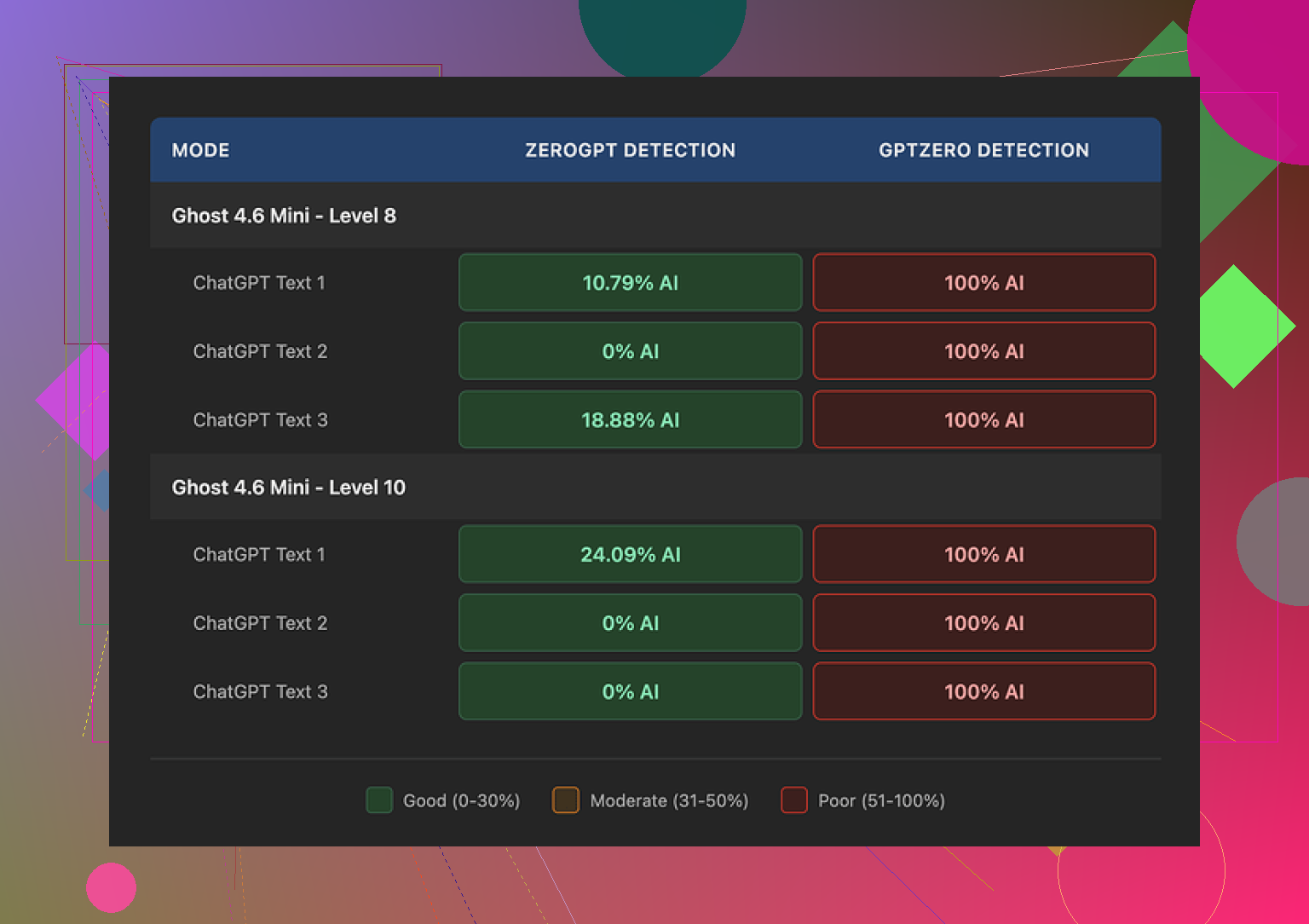
• At intensity 8, some outputs came back at 0 percent “AI”
• Others hovered around 10 to 11 percent
• On paper, that looks good
GPTZero
• Every single run showed as 100 percent AI
• Intensity 5, 8, 10, did not matter
• Engine choice did not matter either
So if your main concern is GPTZero, this tool did nothing useful for me. ZeroGPT numbers looked decent, but that alone does not help much when another detector flags everything.
Writing quality
Level 8 intensity
• I would rate it around 7 out of 10
• Sentences sometimes felt off, like something you would see from a rushed non native writer
• I kept seeing small gaps, like a missing “the” or slightly broken phrasing
• Not unreadable, but I would not paste it unedited into anything that matters
Level 10 intensity
This is where things started to break.
• Quality dropped to roughly 6.5 out of 10
• I got weird injections that did not fit the topic
• Example: “god knows” thrown into a climate science paragraph
• Odd phrasing like:
• “Coastlines areas”
• “feeling quite more frequent flooding”
The higher I pushed intensity, the more the text sounded like someone trying too hard to sound “human” and missing the mark.
One thing it did well
Length control.
Most “humanizer” tools I tried tend to expand your content by 40 to 50 percent. A short 500 word explanation turns into a bloated 800 word mess.
StealthWriter AI mostly kept:
• Structure intact
• Length close to the original
For long form work where you must stay near a target word count, that matters. On that front, it behaved better than a lot of similar tools.
Free tier notes
The free plan gives you:
• 10 humanizations per day
• Up to 1,000 words each
• But no Ghost Pro
If you want the full experience, you need a paid plan, which is not cheap compared with other tools in this niche.
Comparison to another tool
When I tested side by side, I had better outcomes with Clever AI Humanizer.
• Text sounded more natural to me
• It did not mangle phrasing as often
• At the time of writing, it was completely free
If your budget is zero and your goal is more human sounding output, I would start there first.
Practical takeaway
If you are thinking about paying for StealthWriter AI:
• Do not expect it to beat GPTZero, at least based on my runs
• Expect some odd wording at higher intensities
• Expect good control over text length
If your use case is:
• “I need something that passes GPTZero”
You will likely be disappointed.
If your use case is:
• “I need to slightly rearrange wording without inflating length”
Then the tool has one specific niche where it kind of makes sense, as long as you are ready to edit the output by hand.
Short answer. I would not rely on StealthWriter AI as your main long term “rewrite and polish” tool if you care about safety, accuracy, and detection.
Here is the practical breakdown based on what you said, plus what @mikeappsreviewer already tested.
- Detection and “safety”
• GPTZero flagged all outputs in their tests, even on lower “intensity” and on both engines.
• Some detectors like ZeroGPT showed low AI percentages, but detection is inconsistent across tools and changes over time.
• If your main fear is AI detection for school, work, or clients, any “humanizer” is risky. Detectors update, and anti AI policies get stricter.
You should assume detector evasion is unstable, not something you can trust for months or years.
- Originality and plagiarism risk
• These tools reshuffle wording. They do not verify facts, sources, or citations.
• If your base text has weak sources or copied bits, StealthWriter will keep the same issues under slightly changed wording.
• For originality in the SEO sense, search engines care more about value, structure, and intent than about rephrased sentences.
If you want safer originality, write your own base draft, then use tools only for clarity and grammar. Do not feed it random web content and expect “safe uniqueness.”
- Accuracy and weird phrasing
Based on their testing and what others report:
• At medium intensity, output is “ok” but still needs editing.
• At higher intensity, it injects odd phrases and wrong tone, like “god knows” in factual content.
• Small grammar glitches show up, like missing articles or clunky noun phrases.
If your content affects your reputation, grades, or brand, you will need to edit every paragraph. That removes most of the time “savings.”
- Long term reliance
Things to think about if you plan to stick with it:
• Policy risk. Schools, companies, and clients are tightening rules on AI writing every month. Relying on a humanizer as a core part of your workflow increases that risk.
• Vendor risk. If StealthWriter changes models or pricing, your workflow breaks.
• Skill atrophy. If you rewrite everything through a humanizer, your own style and speed get worse over time.
A better long term setup is:
• You write the core content yourself.
• Use an editor tool for grammar, clarity, and structure.
• Use AI more as an assistant, not as a mask.
- About your specific worries
Detection:
If your fear is “will this get my account flagged or my work rejected,” I would treat StealthWriter as unsafe for that purpose. Especially with GPTZero in the mix.
Originality:
If by originality you mean “my own voice and ideas,” tools like this dilute your style. Everything starts to sound the same, and it can even add tone shifts you never use.
If by originality you mean SEO uniqueness, simple rewriting is weak protection. Google looks at usefulness and intent, not only string differences.
Impact on your brand or grades:
If someone checks writing samples across time, humanized text can stand out because of the slight weirdness and mismatched tone. That can hurt trust more than a few rough edges in your original writing.
- What I would do instead
If your goals are:
• Polishing and clarity
Use something more straightforward: grammar checkers, style suggestions, and manual edits. Keep your original structure and tone.
• Human sounding paraphrasing for lighter use
You might want to test Clever Ai Humanizer. Several people, including @mikeappsreviewer, reported more natural output and less broken phrasing. It is worth trying especially if you want smoother text with fewer artifacts.
Link for convenience: try this AI humanizer for cleaner rewrites
Still, treat it as an assistant, not as a shield against detectors.
• Safer workflow
– Write your own rough draft, even if messy.
– Run it through a style or humanizer tool at low intensity, so it tweaks, not rewrites your voice.
– Manually edit for accuracy, tone, and any weird phrases.
– Do not depend on detector scores. Use them only as a reference, not a guarantee.
- Quick SEO friendly version of your topic
StealthWriter AI is a paid rewriting tool that promises to polish content, improve readability, and help text look more “human” for AI detection tools. Many users test it for blog posts, essays, and client work because they worry about originality, detection, and long term safety. Before depending on it, you should weigh the detection risks, the quality of the rewritten text, and how much editing it still needs. You should also compare it to alternatives like Clever Ai Humanizer, which some users find more natural for cleaning up content without bloating length.
If you already feel unsure while testing StealthWriter, that is a signal. These tools work best as small helpers, not as the core of your writing process.
StealthWriter feels like one of those tools that almost solves the problem you want, but not in a way I’d bet my grades / job / clients on long term.
You already saw what @mikeappsreviewer and @shizuka ran into, so I’ll just add a different angle instead of rehashing their tests.
1. On “safety” and detection
If your main fear is AI detectors, StealthWriter is basically a moving target on a moving platform.
Detectors change models, thresholds, and signals all the time. A tool that slips past one today can get nailed tomorrow. GPTZero already tagged everything in @mikeappsreviewer’s runs, which is a pretty loud signal.
I’d treat any humanizer as “maybe it helps, but it definitely doesn’t protect me.” If the risk of being flagged has real consequences for you, you’re gambling here, not building a safe workflow.
2. Accuracy and weirdness in tone
One point where I slightly disagree with the others: I actually think medium intensity can be useful in very narrow situations, like taking something you wrote in “note form” and smoothing it a bit.
But the problems start fast:
- At higher intensity, it starts role-playing “random human on the internet” and injects tone you never asked for.
- That “god knows” example in a climate paragraph is not a small cosmetic issue. It can totally wreck trust if you’re writing for a professional or academic context.
- The tiny grammar glitches make it feel like someone else’s slightly-broken English, which is worse than your own imperfect but consistent style.
So yeah, you can use it, but you’ll need to line edit every paragraph like a hawk. At that point, you have to ask: did it really save you time?
3. Originality & long term impact on your voice
StealthWriter is fundamentally rearranging and rephrasing. It is not:
- Checking facts
- Improving arguments
- Making your ideas sharper
From a “will this hurt my brand / writing over time” angle, my bigger worry is stylistic flattening. If you run everything through a filter, your voice slowly starts to sound like that filter. Then when you have to write without it, your output feels stiff and off, because you were leaning on the tool instead of building your own rhythm.
If you care about originality as in “my stuff sounds like me,” StealthWriter works directly against that when used heavily.
4. Is it worth relying on long term?
Personally, I would not build my workflow around it.
Use cases where it kinda makes sense:
- You wrote something yourself and want light smoothing while keeping the same length.
- You are okay with editing everything manually afterward.
- You are not counting on it to “beat detectors” or “hide AI use.”
Use cases where I’d avoid it:
- Anything graded, legal, medical, or high stakes.
- Client work where tone consistency and trust matter more than pretty sentences.
- Content where a detection flag could get you in trouble.
5. Alternative approach
Instead of relying on StealthWriter as the core tool, you get a better balance with this setup:
- Write a rough draft yourself, even messy.
- Use AI mainly for: clarity, grammar, structure, examples, or brainstorming.
- Keep heavy rewriting to a minimum so your voice stays intact.
If you still want a “humanizer” in the mix for lighter paraphrasing, several people (including @mikeappsreviewer and @shizuka) had smoother results from Clever Ai Humanizer. The outputs usually read more natural and less “strained,” and it doesn’t bloat length as badly as a lot of tools in this space. You can try something like
improving how natural your AI content sounds
and see how its style compares against StealthWriter using your own samples.
Still, same rule: use it as a helper, not a shield.
SEO‑friendly version of your topic
StealthWriter AI is a content rewriting tool that promises to polish your writing, improve readability, and make text appear more human. Many people test it for blog posts, essays, and client work because they worry about AI detection, originality, and long term safety.
The core questions are:
- Is StealthWriter AI safe to use if schools, clients, or employers are running AI detectors?
- Does it actually improve accuracy and clarity, or does it introduce awkward phrasing?
- Will depending on it long term hurt your writing style, credibility, or search performance?
Current tests from users show that some detectors still flag StealthWriter output as AI generated, especially tools like GPTZero. At higher intensity levels, the tool can also inject strange wording and informal expressions that do not fit professional or academic content. While it can keep your word count and structure fairly close to the original, it still requires careful human editing to fix tone issues and minor grammar mistakes.
If you are considering StealthWriter as your main rewriting solution, it is important to weigh the detection risks, the potential impact on your unique voice, and the time you will spend cleaning up its output. Many writers combine their own drafts with lighter editing tools or explore alternatives such as Clever Ai Humanizer when they want more natural sounding paraphrases without sacrificing consistency or long term safety.
So, to your original worry: if you already have that “not sure I can trust this” feeling, you’re probably right to be cautious. Use it as a small part of your toolkit, not the backbone of your writing.
Short version: if you’re already worried about StealthWriter hurting your grades, credibility, or SEO down the line, treat it as a “sometimes tool,” not the foundation of your workflow.
A few angles that haven’t been stressed as much yet:
- Where StealthWriter actually fits
I don’t think StealthWriter is completely useless. It has one fairly specific sweet spot:
- You wrote the original text yourself
- You must keep length and basic structure almost identical
- You only want surface variation for republishing in low‑stakes places (email variants, social captions, internal docs)
In that narrow lane, the rigidness and length control that @mikeappsreviewer noticed is not a bug, it is the feature. You get a light remix that does not balloon into a TED talk.
Outside that lane, the tradeoffs look bad:
- For serious essays or client content, the tone glitches are a liability
- For SEO, pure rewriting of the same ideas is a weak differentiator
- For detection, results are too inconsistent to treat as “protection”
- Detection risk is not just “pass or fail”
One point I disagree slightly on with others: I would not obsess over single detector scores at all. GPTZero flagging everything is important, but the real risk is pattern over time.
If a teacher, client, or platform samples several of your pieces across months and sees:
- Slightly odd phrasing that never matches your spoken voice
- The same kind of “almost native” errors
- Sudden shifts between your unassisted and “humanized” writing
that pattern is often more suspicious than any detector percentage. StealthWriter’s particular quirks (like those informal injections) can become a fingerprint.
So relying on it to “stay safe” while your own voice stays underdeveloped is the biggest long term risk, not just being caught on a single paper.
- Originality: structural vs cosmetic
StealthWriter and tools like it mostly do cosmetic originality:
- Sentence-level rephrasing
- Minor vocabulary swaps
- Occasional rearranging of clauses
What actually protects you in both SEO and academic / professional contexts is structural originality:
- Different angle or argument
- Different examples and evidence
- Different order of explanation and emphasis
If your workflow is “grab source → push through StealthWriter → submit,” both plagiarism and SEO penalties are still on the table. The ideas and structure stay traceable to the original. No intensity slider fixes that.
- Accuracy & trust
Something that has not been highlighted enough: subtle factual distortion.
When a tool aggressively rewrites, it sometimes:
- Softens or exaggerates causality
- Introduces hedging you never meant (“kind of,” “roughly,” “in a way”)
- Swaps precise terms for vague ones to sound more “natural”
For academic, technical, or brand content, those small shifts matter more than a clunky sentence. If one paragraph misrepresents a statistic or a causal chain, the entire piece can lose credibility even if the rest reads fine.
With StealthWriter, you have to proof not just the language but the logic and nuance. That is real time overhead.
- How I would actually use tools in your situation
If I were in your shoes and concerned about detection, originality, and long term impact:
-
Draft from scratch, even messy bullet points
-
Use a general AI assistant or a grammar tool to:
- clarify sentences
- suggest better structure
- tidy grammar and transitions
-
Avoid heavy “rewrite my whole thing” passes as your default
-
For places where you really want paraphrasing:
- keep intensity low
- compare your original with the rewrite side by side
- restore your own phrases where the tool goes off-tone
- Where Clever Ai Humanizer fits in
Since it keeps coming up, here is a practical take on Clever Ai Humanizer in this context.
Pros:
- Often more natural flow than what people observed from StealthWriter at high intensity
- Tends not to inflate text length as much as many paraphrasers, so closer to your original pacing
- Good for taking obviously “AI-ish” text and sanding down the robotic rhythm for casual content
Cons:
- Same core limitation as any humanizer: it does not verify facts or citations
- Still adds a “house style” on top of your voice if you lean on it too hard
- Detector performance today tells you almost nothing about detector performance in six months
- You still need line edits if your reputation or grades matter
So yes, if you really want a tool in that niche, testing Clever Ai Humanizer on a few of your own samples is reasonable. I would use it mainly to smooth already original work, not to disguise AI or copied text.
- About relying on any of these tools long term
Where I strongly agree with @shizuka, @vrijheidsvogel, and @mikeappsreviewer: making a humanizer the core of your stack is a long term trap.
- Policy trend is against you
- Vendor and pricing risk are outside your control
- Your personal style stagnates under a layer of generic “AI-natural” varnish
Where I am a bit more optimistic than some: using tools in a transparent, low‑intensity way can actually accelerate your skill, as long as:
- you always start from your own thoughts
- you review suggestions critically instead of accepting them blind
- you keep some writing fully “unassisted” so your natural voice keeps evolving
If using StealthWriter is already triggering that “this feels sketchy” instinct, listen to it. Keep it, or any humanizer, on the fringes of your workflow and push your main effort toward drafting, structuring, and refining your own words. That is the part no detector, policy, or price change can take away.
StealthWriter solves the wrong problem. It changes wording, yet leaves you checking facts, tone, and detector scores. Your results, 100 percent AI on GPTZero and weaker phrasing at intensity 10, make long-term reliance hard to defend.
Try voice-first editing instead. Read your draft into phone dictation, then trim the transcript yourself. Spoken wording preserves your normal rhythm and exposes wierd claims fast. Compare each factual sentence with its source. This takes 10 to 15 minutes per 500 words, avoids another subscription, and keeps your voice intact. It also feels alot less risky.
Before you pay for anything, run your own worst-case sample through both detectors first, not the demo text the tool likes. The @caminantenocturno point about pattern over time is the real risk, so keep some pieces fully your own so your baseline voice still exists. Clever Ai Humanizer is fine for sanding down one rough paragraph, but I wouldn’t lean on any of these to actually clear GPTZero.