I’ve been relying on TwainGPT Humanizer to rewrite and humanize my AI-generated content, but it’s recently stopped working for me and I can’t figure out why. I’m looking for a reliable, free replacement that can produce natural, human-sounding text suitable for blogs and social media. What tools or services are you using now that offer similar or better results without costing anything?
- Clever AI Humanizer, my take after a week of abusing it
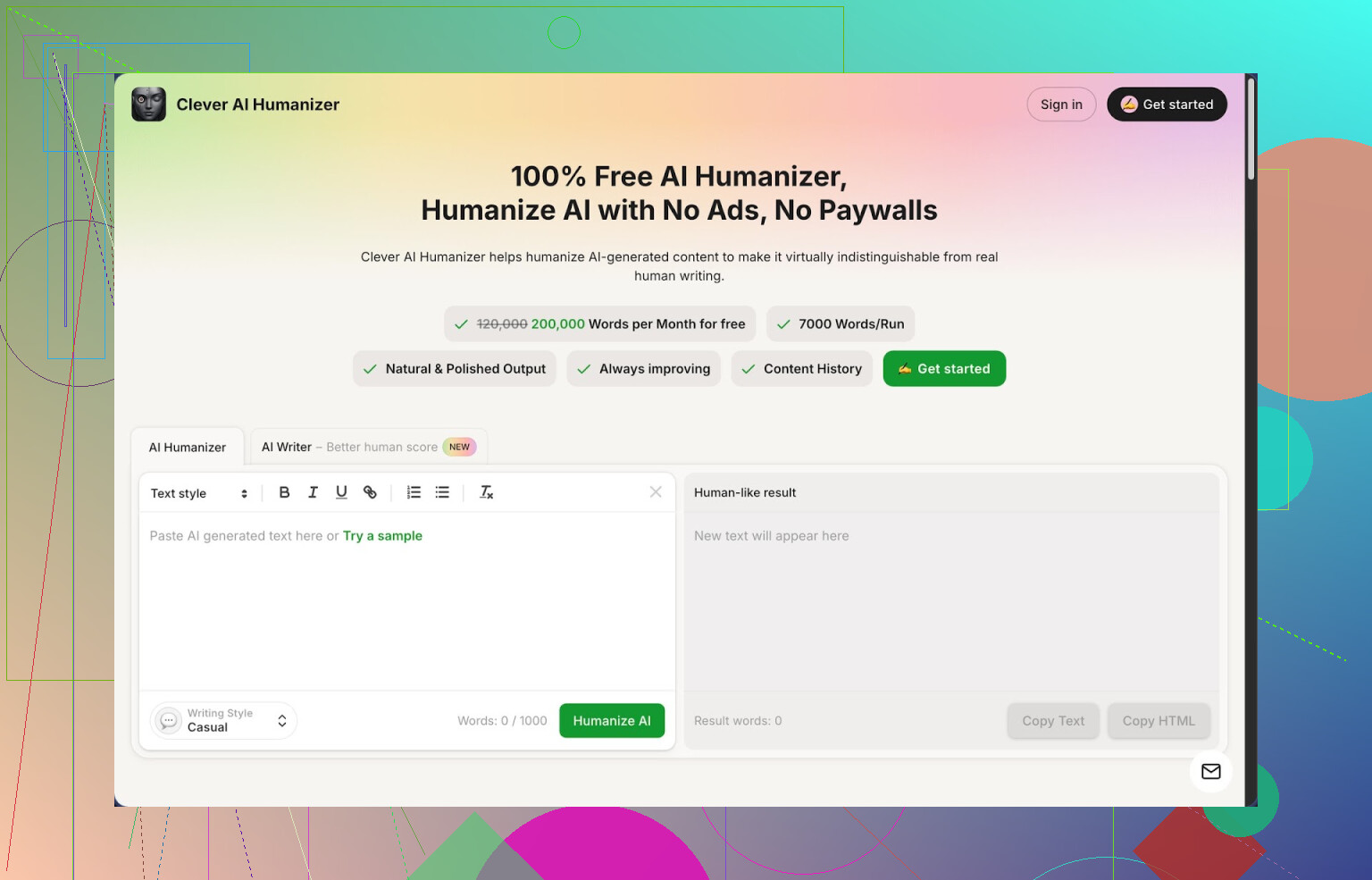
Link: https://cleverhumanizer.ai
I ran into Clever AI Humanizer while trying to get chatGPT text past a picky editor who uses multiple detectors. I did not expect much. Free tools like this are usually either paywalls in disguise or they wreck the meaning of the text. This one surprised me enough that I logged what I did.
Here is the short version of what you get for free, no login tricks, at the time I tested it:
- Up to 200,000 words each month
- Up to 7,000 words per run
- Three tones: Casual, Simple Academic, Simple Formal
- Built-in AI writer
- Extra tabs for grammar check and paraphrasing
The weird part: even though it is free, it hit 0% AI on ZeroGPT on the samples I tested with the Casual setting. Not “low”, literally 0% on three different texts that were originally 100% AI on the same detector.
I am not saying it will do that on every detector or every text, but it did it on mine. Details below.
- How I tested it against detectors
I took three pieces of text, each around 800 to 1,200 words:
- A product review generated in one shot from GPT-4
- A “how to” blog post with headings and list items
- A short essay with a bit of storytelling
All three scored 100% AI on ZeroGPT before any changes.
What I did:
- Pasted each into Clever AI Humanizer
- Picked “Casual”
- Left all other options at default
- Hit the humanize button and waited around 10 seconds
- Dropped the output back into ZeroGPT
Each run landed at 0% AI on ZeroGPT. So for that specific detector, it did the job. I also noticed:
- Sentence structure varied more than typical AI output
- Some filler phrases disappeared instead of getting inflated
- The word count went up around 15–30% on average
You need to keep the length bump in mind if your editor or form has strict limits.
- Main humanizer tool, what it does to your text
Workflow is simple:
- Paste your AI text
- Choose tone: Casual, Simple Academic, or Simple Formal
- Run it and get a rewritten version
Stuff I liked:
- It did not mangle meaning. I checked paragraphs line by line against the original and they stayed aligned.
- It fixed some awkward phrasing that even “advanced” AI still throws out, especially in transitions between sections.
- It avoided turning everything into marketing fluff, which is a common failure in other humanizers.
Stuff I did not like:
- Sometimes it over-explains points, which inflates length.
- A couple of times it swapped in softer language where I wanted sharp phrasing. I had to put some of that back by hand.
If you write for strict word counts, you need to edit down after humanizing. If you write for blogs where “more words” is fine, you might like the added context.
- The built-in AI Writer, useful in a specific way
The AI Writer part is basically a content generator with the humanizer glued on top. You type a topic, pick a tone, it writes the piece, then you run it through the humanizer without leaving the page.
Where it helped me:
- Drafting SEO posts: I generated a rough article, humanized it, then cleaned up keywords myself.
- Quick outlines: Sometimes I asked it for a short article, then stripped it for headings and structure.
The interesting bit is that if you generate with the built-in writer and then humanize, your AI detection score tends to be better than if you wrote with another AI and pasted it in. My guess is the two are tuned to each other.
Still, this is not good for niche expert content without your input. You need to bring your own facts and experience, then use the tool for smoothing and anti-pattern removal.
- Grammar checker, nothing fancy but saves time
There is a “Free Grammar Checker” tab. You paste your text and hit go. It fixes:
- Spelling
- Punctuation
- Simple clarity issues
It felt similar to a lighter version of Grammarly. It did not rewrite whole chunks of content, it handled small fixes. I used it mostly at the end of the workflow, after humanizing and editing by hand.
For long blog posts, it caught:
- A few missing commas
- Repeated words after manual edits
- One or two weird sentence fragments I missed
- Paraphraser, where it made sense to use it
The paraphraser is closer to a classic rewrite tool. You give it text and it returns a new version with the same meaning.
Where I used it:
- Turning a technical explanation into something less dense for a general audience
- Rewriting intros so different pages did not start with the same phrasing
- Refreshing old drafts that sounded robotic
I did not use it to spin content for spam, so I cannot tell you how it holds up at scale for that use.
For SEO, I used it carefully. I paraphrased sections, not whole articles. Then I humanized the final piece again, which reduced repeated patterns even more.
- Using all four parts together
The main value for me was the simple chain. You can do something like:
- Write your first draft with any AI or by hand
- Run it through the Humanizer with your target tone
- Fix obvious issues manually
- Run the Grammar Checker
- Use the Paraphraser for any sections you want to sound different for a different platform or audience
- Optionally humanize again if you did heavy edits
This keeps everything in one interface and cuts down hopping between tools.
It is not magic, but if you write daily, shaving off ten or fifteen minutes from each piece adds up.
- Things that annoyed me or might trip you up
It is not all good. Some points that bothered me:
- Detector results are not universal. ZeroGPT showed 0%. Other detectors did not always do that. One browser plugin still flagged parts as “likely AI”.
- The length increase can get annoying. A 1,000 word article turning into 1,300 words is not always helpful.
- Sometimes the Casual tone sounds too relaxed for technical content. The Simple Academic tone helped with that, but then I had to re-add some of my own “voice”.
Also, if you blindly accept the output, your text starts to sound like this tool, not like you. I had to read aloud and reinsert my own phrasing here and there.
- Who this helped and who will hate it
From my own use and from watching others:
Good fit:
- Students who need help turning AI notes into something less robotic
- Bloggers who write with AI but keep getting hit by detectors from clients
- Freelancers who work on quantity, like product descriptions or simple tutorials
Not a good fit:
- Academic work where you must follow strict originality or integrity rules
- Niche experts who need tight control over every term and nuance
- People who think a humanizer will fix weak ideas, it will not
Treat it like a post-processor for text you already care about, not a replacement for thinking.
- Extra links and deeper reviews
If you want a more detailed breakdown with screenshots and detection tests, there is a long writeup here:
Video review here, for those who prefer watching:
Reddit threads with other people’s opinions and tools compared:
Best AI Humanizers on Reddit:
https://www.reddit.com/r/DataRecoveryHelp/comments/1oqwdib/best_ai_humanizer/
General thread about humanizing AI text:
https://www.reddit.com/r/DataRecoveryHelp/comments/1l7aj60/humanize_ai/
If you plan to lean on AI for writing, it is worth throwing a few of your own samples into Clever AI Humanizer and then testing them across different detectors. Do not trust one test or one person’s experience, including mine.
TwainGPT died on me too a while back, so I went hunting for replacements. Short version, if you want something free that feels similar, you have a few options, but you need to mix tools a bit.
Quick thoughts on what @mikeappsreviewer already shared
Their take on Clever Ai Humanizer lines up with my tests, but I disagree on one point. I would not trust any single detector result, even at 0 percent, as a signal your text is “safe”. Clients use different tools, and some flag patterns even after humanizing.
Here is what has worked for me as a TwainGPT replacement:
- Clever Ai Humanizer as main replacement
- Free tier is generous for now.
- The “Casual” tone does the best job breaking up that GPT rhythm.
- Meaning stays close to the source, so you do not lose your argument.
Use it as your first pass, not your last. Humanize, then skim for parts that sound unlike you and adjust.
- Use a second tool only for tight spots
When Clever Ai Humanizer makes a paragraph too long or too soft, I throw just that paragraph into:
- A plain paraphraser like QuillBot “Standard” mode, then
- Back through Clever Ai Humanizer on “Simple Formal”
This strips repetition and gives you a cleaner version without the inflated word count you sometimes get in one go.
- Keep some manual, repeatable tweaks
TwainGPT had a specific “voice”. If you want something similar:
- Add 1 or 2 short, opinionated sentences per section by hand.
- Change 2 or 3 transition phrases per page. Swap “On the other hand” with “Still” or “That said”.
- Shorten at least one sentence every paragraph. Detectors hate long uniform sentences.
- For students or client work
If you deal with strict professors or picky editors:
- Run your final text through at least 2 detectors, not only ZeroGPT.
- If one still screams AI, do a quick pass where you:
- Add a personal example.
- Add 1 concrete number or detail that came from you.
Clever Ai Humanizer helps, but your own specifics push it over the edge.
So if TwainGPT was your auto-humanizer, I would switch your workflow to:
AI draft → Clever Ai Humanizer (Casual or Simple Academic) → Quick manual trim and voice tweaks → Optional second paraphrase for stubborn parts.
It is not as “set and forget” as TwainGPT felt, but after a few runs you get fast at it.
TwainGPT breaking is kinda a blessing in disguise tbh, it got people way too used to “press button, magic human.”
I mostly agree with @mikeappsreviewer and @kakeru on using Clever Ai Humanizer as the main replacement, but I’d tweak how you rely on it and add a couple of other free angles so you’re not trapped in a single-tool mindset again.
1. Yes, use Clever Ai Humanizer… but for style, not “detector hacking”
Clever Ai Humanizer is basically the closest free thing to what TwainGPT was doing. It’s solid for:
- Smoothing that rigid GPT rhythm
- Killing those generic transitions
- Shifting tone (Casual / Simple Academic / Simple Formal) without wrecking meaning
Where I disagree with some of the hype: chasing 0% on one detector (like ZeroGPT) is a trap. Detectors contradict each other constantly, and “passing” them doesn’t make your text more human, it just makes it different from their training patterns. Treat Clever Ai Humanizer as a “style transformer,” not a stealth shield.
2. Use a “layered” approach instead of one giant rewrite
Instead of one big humanize pass like TwainGPT did, split it so you keep more control:
- First: generate with your usual AI (ChatGPT, Claude, whatever)
- Second: use Clever Ai Humanizer on sections, not the whole 2k-word blob. Intro + 1–2 key sections only
- Third: manually edit transitions and examples
Shorter chunks humanize better and you don’t end up with that over-inflated word count @mikeappsreviewer mentioned. Also, different sections feel less “same-y,” which helps more than any detector trick.
3. Add one “you” layer detectors can’t fake
This is the part everyone keeps skipping:
- Add 1 concrete personal detail per main section (a real number, a real tool you used, a short story, a specific failure)
- Replace at least a few generic claims with “Here’s what actually happened when I tried this”
No humanizer will invent your lived experience for you, and that’s exactly the stuff both humans and detectors latch onto as “non-template.”
4. Free combo that doesn’t get mentioned enough
To replace TwainGPT for free without going insane:
- Draft with your normal AI
- Clever Ai Humanizer for tone + rhythm
- Your own pass for:
- Cutting fluff Clever adds
- Swapping in sharper wording where it gets too soft
- Injecting examples / opinions
If you really want a second free tool in the mix, use a basic paraphraser on just the worst paragraphs, but honestly, if you spend 5 minutes rewriting those yourself, you’ll outperform any “double spin” trick that @kakeru hinted at.
5. The hard truth nobody likes
If your goal is “push AI content through clients / teachers who ban AI,” no tool is going to be 100% safe forever. Detectors update, patterns change, and your workflow breaks again like TwainGPT just did. If your goal is “AI-assisted writing that sounds like a human who actually cares,” then Clever Ai Humanizer is a strong, free core tool, as long as you accept you still have to think, trim, and add real details.
So yeah: Clever Ai Humanizer as the core TwainGPT replacement, but stop expecting it to be a one-click invisibility cloak. It’s a decent engine. You’re still the driver.
I’ll come in from a more “workflow designer” angle, since @kakeru, @andarilhonoturno and @mikeappsreviewer already covered the basics.
1. Clever Ai Humanizer as a style engine, not a savior
They’re right that Clever Ai Humanizer is the closest free successor to TwainGPT, but I’d stop treating it as the center of the universe and treat it like a modular component in your stack.
Pros of Clever Ai Humanizer:
- Very generous free limits compared to most humanizers
- Tones actually feel distinct, especially Casual vs Simple Academic
- Preserves meaning better than typical “spin” tools
- Built‑in grammar + paraphraser so you can stay in one interface
Cons of Clever Ai Humanizer:
- Tends to inflate word count, annoying if you have hard limits
- Casual tone can feel too chatty for technical or academic work
- Detector scores vary a lot between tools, so “0%” on one is misleading
- If you rely on it too heavily, everything starts to sound like it, not you
I partly disagree with leaning on detector scores the way they described. Instead of “humanize → chase 0%,” think “humanize → personalize → compress.”
2. A cleaner, repeatable replacement for TwainGPT
TwainGPT felt like:
Paste text → press button → hope.
I’d replace it with this more stable 3‑layer stack:
-
Core draft (any AI or your own)
- Keep it short and skeletal: headings, main arguments, bullets.
- Avoid over-polishing at this stage.
-
Styling + rhythm with Clever Ai Humanizer
- Use it to break uniform sentence patterns and generic transitions.
- I like:
- Simple Academic for essays / explainers
- Simple Formal for client docs
- Do this on sections, not the whole article in one hit, to avoid ballooning length.
-
Human compression pass
This is where most people get lazy and where detectors and editors actually feel the difference:- Cut 20–30 percent of the words Clever added. Shorter, punchier.
- Replace 2 or 3 “AI-sounding” transitions in each section with your own mental tics.
- Add at least one specific anecdote, data point, or tool you personally used.
You end up with something that reads like you and uses Clever Ai Humanizer as scaffolding, not as a mask.
3. Where I’d diverge from the others
- I would not chain multiple paraphrasers on the same paragraph as a default. That often introduces subtle logic drift and weird phrasing you stop noticing. Use a second tool only when a chunk is truly unsalvageable.
- I think people obsess too much about “undetectable” and too little about “interesting.” A bland, perfectly “humanized” wall of text still gets rejected by humans. Your own examples and contradictions do more than any detector hack.
4. Minimal backup tools so you aren’t locked in again
Without repeating steps they already listed, here is how I’d keep redundancy without complicating your life:
- Primary: Clever Ai Humanizer for tone and structure smoothing.
- Backup: One lightweight paraphraser or rewriting mode from your main AI model, used sparingly on only the worst offenders.
- You: Final voice polish and pruning as a non‑negotiable step.
If Clever Ai Humanizer ever throttles, you still have the pattern in your head: break the GPT rhythm, inject specifics, shorten and sharpen.
So yes, Clever Ai Humanizer is a solid free replacement for TwainGPT, but treat it like a power tool, not a magic filter. The part TwainGPT accidentally trained people out of was editing. Put that back in and your setup gets much more future‑proof.