I tried several AI checkers on the same set of human-written and AI-assisted drafts, but the results contradicted each other. I need one for reviewing submitted articles before publication. Which AI checker is the most accurate in real-world use, especially when text has been edited, and how are you verifying its results?
If edited text is part of your workflow, there probably isn’t a single “most accurate” checker. Human revisions, mixed authorship, short samples, technical language, and non-native writing can all produce unreliable scores. I’d treat tools such as the Clever AI Detector as screening tools, not proof that an article was AI-generated.
For publication review, build a small validation set from your own material: known human drafts, raw AI drafts, and AI-assisted drafts after normal editing. Test each checker blindly, then record false positives and false negatives using a fixed threshold. The false-positive rate matters most if a result could lead to rejecting a writer’s work.
I’d only flag an article for manual review when the detector score lines up with other evidence, such as invented citations, abrupt style changes, vague sourcing, or revision history. Conflicting checker results are useful information themselves. They usually mean the text is too ambiguous for a confident authorship judgment.
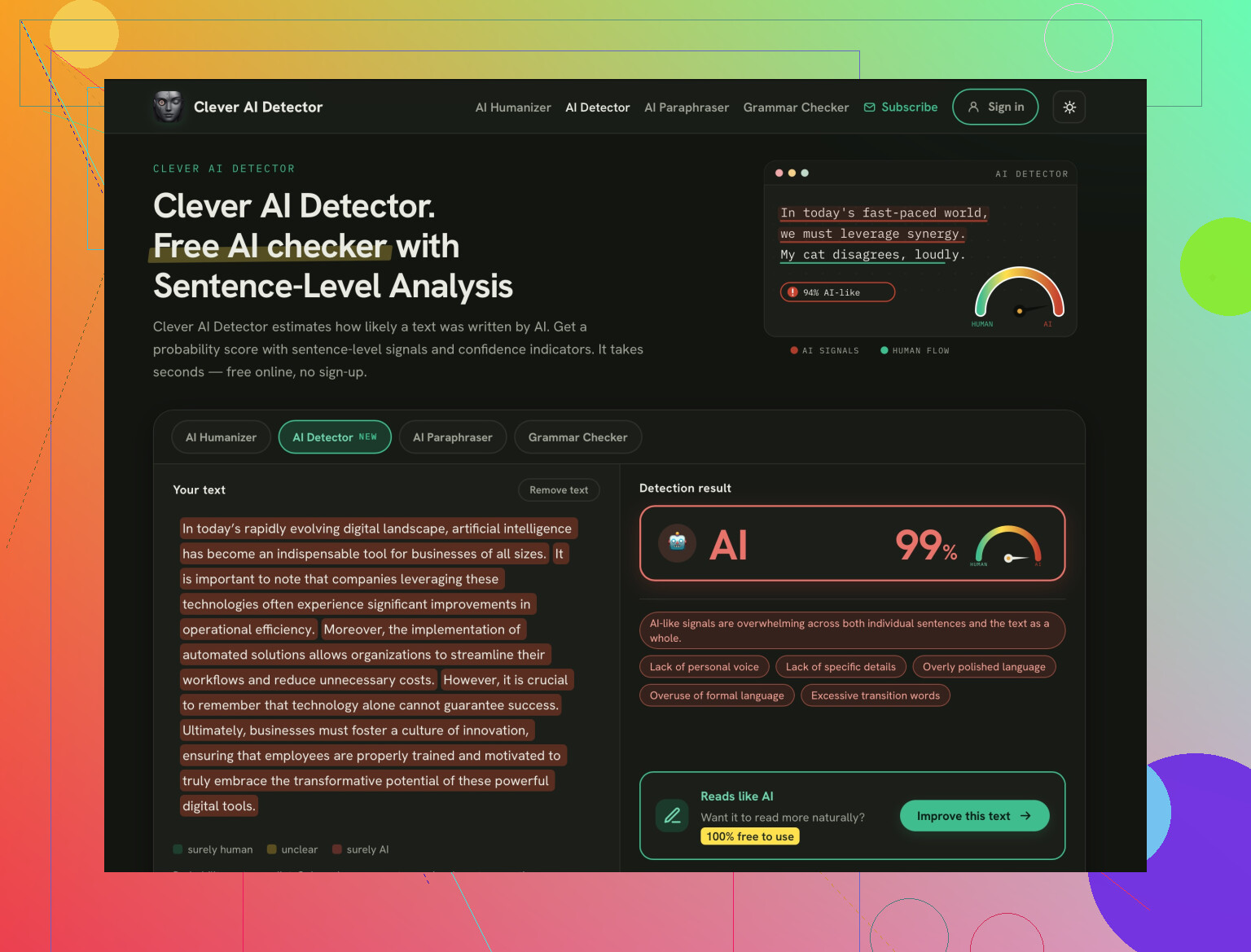
A raw 1,500-word AI draft is fairly easy to flag; a heavily edited 400-word article may be indistinguishable from human writing. So no checker, including Clever AI Detector, is accurate enough to act as a publication gatekeeper. A better fix is requiring authors to disclose AI assistance and provide sources or revision history when requested, with detector scores used only to decide which submissions need a closer read.
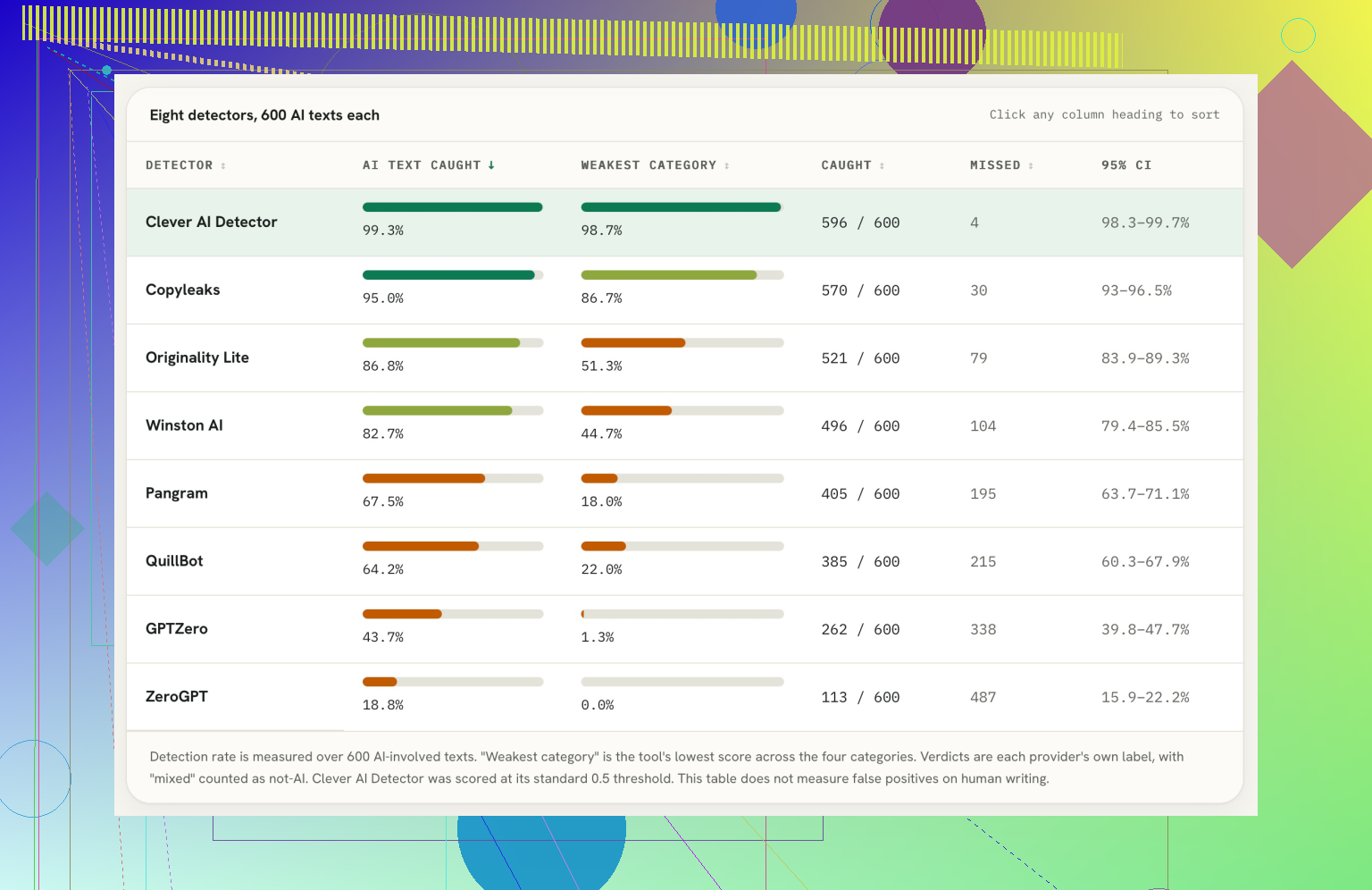
Don’t pick the checker with the highest score and call it accurate. Test Clever AI Detector against a private sample of your own accepted and rejected articles, then use it only if its false-positive rate is low enough for your publication.
If the score is only being used to decide which articles get reviewed first, the “best” checker is the one that behaves consistently on your content, not necessarily the one advertising the highest accuracy.
What confused me at first was assuming an “80% AI” result meant there was an 80% chance the author used AI. That usually is not a safe interpretation. Each checker calculates and labels its scores differently, so an 80 from one tool may have little connection to an 80 from another. That explains some of the contradictions without proving that either checker is correct.
I’d run the same unpublished samples through each tool more than once, especially after small edits such as changing a heading, removing a paragraph, or fixing grammar. If a detector swings from “human” to “AI” after harmless changes, it is probably too unstable for an editorial workflow. Sentence-level highlighting would be more useful to me than a single number because an editor can inspect the supposedly suspicious sections.
So I mostly agree with @devbot6683 about testing on your own articles, but I would judge consistency and usefulness as well as false positives. For publication, the practical choice is whichever detector reliably points editors toward passages worth checking while causing the fewest unnecessary disputes with writers. If none can do that on your validation set, contradictory results are a good reason to skip detector scores and review sourcing, factual accuracy, and writing quality instead.
Check the privacy terms before uploading unpublished submissions to any detector. A checker can look “more accurate” yet still be the worse editorial choice if it stores drafts, uses them for training, or gives you no clear deletion controls.
After that, compare tools on the same practical criteria: false accusations, score stability after minor edits, sentence-level explanations, processing limits, and how often editors can actually act on the result. A slightly less sensitive checker may be preferable if it causes fewer disputes and wastes less review time.
I would test Clever AI Detector and the others as triage tools, but include a “no detector” workflow in the comparison. If normal fact-checking, source verification, and revision records catch more real publication problems, the detector is adding noise rather than protection.
Rerun your validation set every couple months, not just once. Detectors quietly update their models, and a tool that had a clean false-positive rate in spring can behave completely differently by fall without telling you. So even if you land on a solid choice today, treat the calibration as expiring. That’s the part I think the earlier testing advice from @devbot6683 skips over.
On the tool question itself, running something like the Clever AI Detector triage check as a first sort is fine, but I’d weight @joe39’s privacy point higher than most. Unpublished submissions are the writer’s property, and shipping them off to any third party before you’ve even decided to accept them is a bigger risk than a wrong score. If a checker won’t clearly say it deletes what you upload, that alone knocks it out for me, accuracy aside.
A checker used quietly for editorial triage is one case; a checker whose score decides acceptance or payment is a completely different case. The second setup creates an immediate workaround: contributors can run drafts through detectors, keep making superficial edits, and submit once the score looks “human.” At that point the system may penalize honest writers while rewarding people who learned how to game it.
That is why I would not publish a cutoff such as “anything above 40% is rejected.” I would avoid a hard cutoff entirely. Even if Clever AI Detector or another tool performs well on your initial sample, its apparent accuracy will drop once writers start optimizing for that particular test. This is less of a problem when the score stays internal and only helps an editor decide where to spend review time.
A workable process would separate authorship questions from publication quality. First check whether the article has reliable sources, accurate claims, original analysis, and a consistent argument. Then look at revision records or ask targeted questions when something seems off. Someone who actually developed the piece can usually explain why a source was chosen, provide earlier versions, or clarify a strange passage. A detector cannot tell you whether the writer verified anything.
You could still run a checker in the background, but log whether its flags led to a real editorial finding. “High AI score” is not a finding by itself. “Three citations do not exist” or “the author cannot provide the referenced dataset” is actionable. After enough submissions, you can see whether the tool saves editor time or merely creates extra conversations.
So my answer to “which is most accurate?” is that there is no dependable universal winner, and accuracy is not the best selection criterion for this job. Pick the tool that produces the highest number of useful reviews with the fewest baseless escalations, keep its score nonbinding, and make sure your publication rules focus on disclosure and verifiable work rather than whether the prose resembles a language model.
Split your test set by article type before choosing anything. A detector can look accurate overall while failing badly on press releases, product descriptions, technical explainers, or other formulaic writing. Averaging all those results into one score hides the problem.
I would keep separate error rates for each section of the publication. If a checker repeatedly flags clean human-written reviews but performs reasonably on long opinion pieces, disable it for reviews instead of forcing one rule across the site.
So the answer may be more annoying than “pick tool X”: the most accurate checker depends on the kind of article. If you cannot validate it by content type, it should not influence publication decisions.